
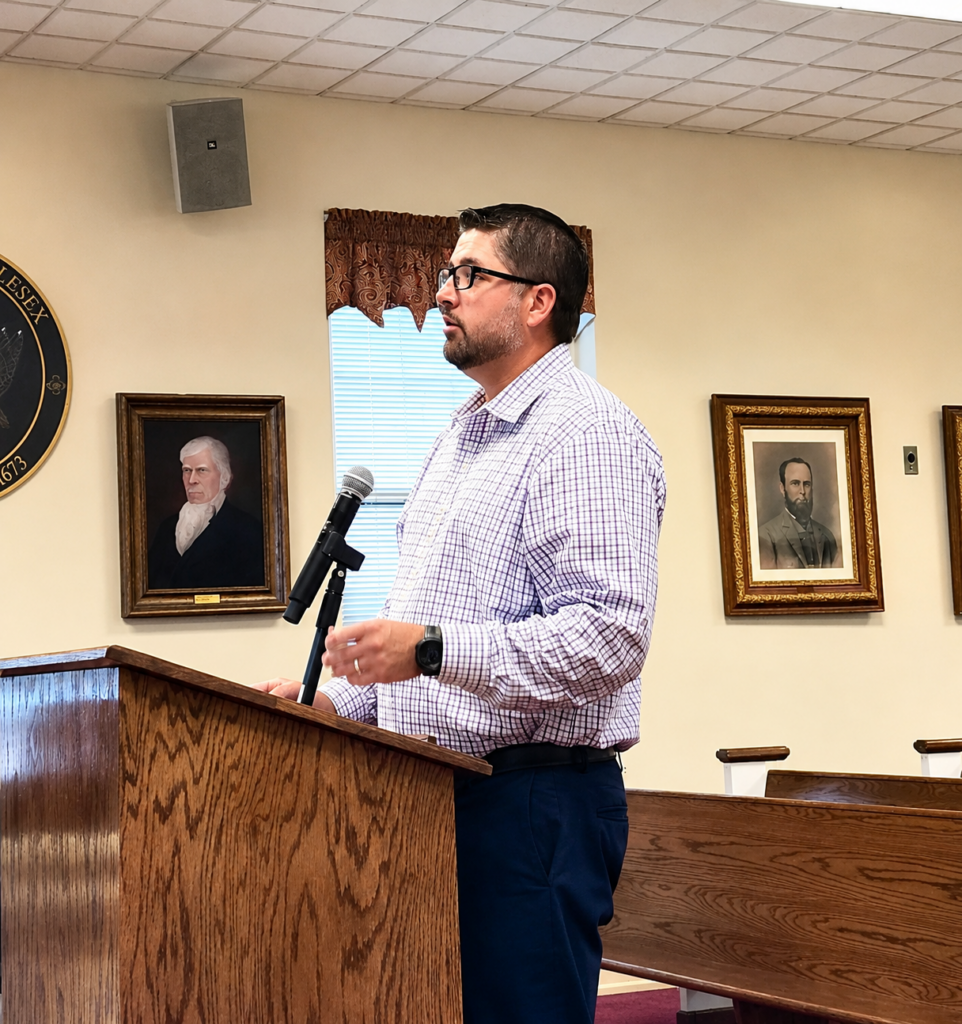
At its August 2026 monthly meeting, the Middlesex County Economic Development Authority received a presentation from Richard Wiatt, VHB Project Manager with Vanasse Hangen Brustlin (VHB), on a regional planning initiative that positions Middlesex County at the center of a significant waterfront infrastructure investment opportunity.
About the Initiative
Funded through a federal RAISE grant, the initiative — formally titled “Designing Multimodal Working Waterfronts to Meet the 21st Century Needs of Rural Coastal Seafood and Maritime Industries” — was led by VHB in partnership with the Middle Peninsula Planning District Commission (MPPDC). Over two years, the project conducted a condition assessment of more than 60 publicly owned wharves, landings, and harbors across the Middle Peninsula, spanning Middlesex, Essex, Gloucester, King & Queen, King William, and Mathews counties. The goal: create shovel-ready projects that build resilient, efficient infrastructure for the regional seafood industry, stimulate economic growth, and generate employment opportunities.
The study’s focus is exclusively commercial. Virginia’s Middle Peninsula seafood economy — crabs, oysters, clams, and finfish — depends on a chain of access points where watermen offload their catch for processing, distribution, and sale. The speed and ease of moving product from dock to truck directly affects a waterman’s revenue. Site improvements targeted by the study include dock heights, turning radii to accommodate box trucks, offloading space, and shell recycling logistics. This is working waterfront infrastructure, not recreational access.
Middlesex County’s Strong Position
Starting from a field of 63 publicly owned waterfront sites, the analysis narrowed to 26 and then to 11 final priority sites through a structured scoring and alternatives process. Sites were evaluated across four categories: equity, distance and water access, physical conditions, and implementation readiness. Middlesex County holds four of the five highest-scoring sites in the region, a result that reflects both the quality of the county’s waterfront assets and the commercial significance of its maritime corridor.
Three Middlesex sites are among the 11 regional priorities:
Whiting Creek Landing provides access to the Rappahannock River. Concept plans include a concrete fixed pier for commercial offloading, an improved boat ramp, a floating courtesy dock, heavy duty paving, and turnaround space sized for commercial vehicles.
Mill Creek Landing also serves the lower Rappahannock River. Plans call for a concrete fixed pier, a timber fixed pier with six wet slips and a wave screen, a 90-foot diameter turnaround for commercial and recreational vehicles, and improved parking.
Stamper’s Bay Landing provides access to the Piankatank River. Plans include a timber fixed pier for commercial offloading, an improved boat ramp, a 60-foot diameter turnaround, and trailer parking spaces.
For all three sites — and all 11 priority sites across the region — VHB has already completed 30% engineering plans, grading designs, dock and structural drawings, and draft Joint Permit Applications (JPAs). These materials are owned by the MPPDC and are available to localities now, representing a substantial head start toward formal grant applications and construction.
Broad Creek and Project Access
Broad Creek was not included in the original study because the property was not publicly owned at the time of the assessment. The EDA acquired the 21-acre site in October 2025 as the foundation for Project Access, its two-phase initiative to establish a public boat ramp and marine industry training facility in Deltaville. Broad Creek has since been identified as the county’s top-priority site within the Working Waterfronts framework — and the initiative is already producing results. A $1.5 million planning grant was awarded to advance the Broad Creek boat ramp, adding to the $1,595,720 federal BUILD grant awarded in July 2026 for construction-ready design work.
Learn more about Project Access.
View the full presentation from the August 2026 EDA meeting.
Learn more about the Middle Peninsula Planning District Commission’s Working Waterfronts initiative at mppdc.com/programs/working-waterfronts or the VHB project summary at vhb.com/news/working-waterfronts-framework.